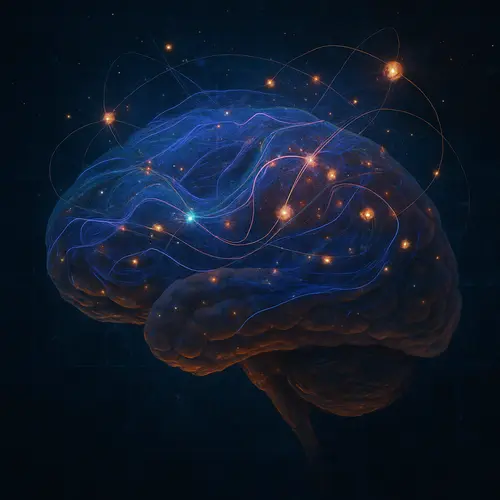
🧠 Introduction: Where Physics Meets the Mind
What is consciousness? Despite centuries of philosophical inquiry and decades of neuroscience, we still don’t have a definitive answer. But one of the boldest—and most controversial—theories proposes something radical: your mind may operate on quantum principles.
This is the essence of the Quantum Consciousness Hypothesis. It suggests that the brain is not just a bioelectric machine but a kind of quantum computer—processing information at a level beyond classical physics. It’s a theory that bridges neurons and qubits, synapses and superposition. And it could reshape how we understand both consciousness and reality.
🔬 What Is Quantum Consciousness?
Quantum consciousness proposes that consciousness emerges from quantum mechanical processes—such as entanglement and superposition—within the brain’s microstructures. Unlike classical computing, quantum computing allows for multiple states to coexist, information to be non-locally connected, and computations to be probabilistic rather than deterministic.
If the brain leverages these quantum properties, it may explain why consciousness feels so different from other biological processes—fluid, holistic, nonlinear.
🧠 The Orch-OR Theory (Penrose & Hameroff)
The most well-known theory in this space is Orchestrated Objective Reduction (Orch-OR), developed by physicist Roger Penrose and anesthesiologist Stuart Hameroff.
It proposes that quantum computations occur inside the brain’s microtubules—tiny cylindrical structures within neurons. According to Orch-OR, consciousness arises when these quantum states “collapse” in orchestrated, non-random ways, creating moments of conscious awareness.
In this view, the brain isn’t just a wet machine—it’s a quantum information field generating awareness in discrete flashes.
📡 Why Quantum Effects Matter
- Superposition: A quantum system can exist in multiple states at once. Could this explain how we hold contradictory ideas or intuitions simultaneously?
- Entanglement: Distant particles can be instantaneously correlated. Could this be behind our sense of holistic awareness—or even telepathic phenomena?
- Quantum Collapse: The moment a probability becomes a reality. Could this be the neurological root of “decision” or free will?
🧪 Supporting Clues
- Quantum coherence has been observed in photosynthesis, bird navigation, and even in warm biological systems.
- Some studies suggest anesthetics affect consciousness by disrupting quantum vibrations in microtubules.
- Recent models of cognition show limits in classical computation to explain consciousness’s non-local, unified nature.
Though still controversial, the idea of biological quantum computation is no longer dismissed outright.
⚠️ The Criticism
Many physicists and neuroscientists remain skeptical:
- The brain is too warm, wet, and noisy for delicate quantum states to survive (they decohere quickly).
- No direct experimental evidence proves quantum computation occurs in neurons.
- Consciousness may arise from classical processes we simply don’t yet understand.
Yet the theory persists—because classical theories alone still struggle to explain subjective experience.
📽️ Quantum Consciousness in Sci-Fi
- Lucy (2014): Explores heightened brain function and non-linear time awareness.
- Transcendence: A mind is uploaded and operates across networks—possibly mimicking quantum behavior.
- Doctor Strange: Blends mysticism with quantum multidimensional awareness.
Sci-fi has long intuited that mind and matter are linked in ways our models struggle to define.
🌌 Philosophical Echoes
Quantum consciousness echoes ancient and Eastern philosophies:
- Vedanta: The world is Maya (illusion); true consciousness is universal and indivisible.
- Buddhism: The self is not fixed; awareness is emergent and interdependent.
- Plato: Reality has deeper forms beyond physical perception.
Perhaps quantum physics is catching up with ancient intuition.
📘 Final Thoughts
Quantum consciousness may or may not prove true. But it opens vital questions:
- Is the brain more than a machine?
- Could consciousness be a fundamental feature of the universe, like gravity or space-time?
- And if the mind is quantum, what else might we become?
In the dance between neurons and quantum waves, we may glimpse a new model of being—one that transcends both biology and circuitry.
“Consciousness cannot be located in space or time. It might be the very fabric of both.”