🧠 Introduction: The Oldest Dream Meets New Tech
For millennia, humans have yearned to outlive death—not just through legacy or story, but through actual consciousness. Ancient mythologies spoke of immortal gods, alchemical elixirs, or spiritual ascension. But today, science fiction inches closer to science. What if immortality isn’t biological, but digital? What if we could upload the human mind?
This question, once confined to speculative fiction, is now being explored in neuroscience labs, AI think tanks, and tech conferences. The dream of digital immortality—preserving consciousness outside the body—sits at the intersection of ethics, engineering, and existential philosophy.
🧬 What Does It Mean to Upload a Mind?
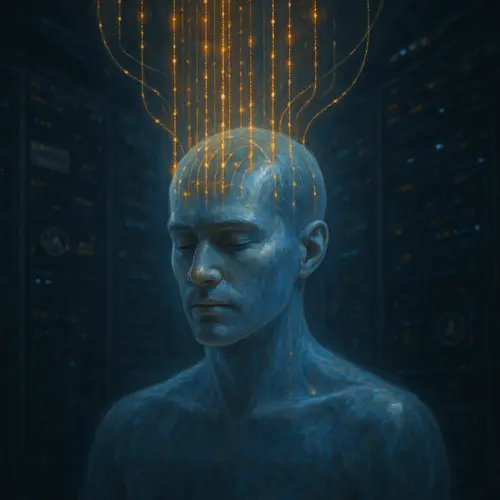
Mind uploading, also known as whole brain emulation (WBE), is the theoretical process of scanning and mapping the neural structure of a human brain in such fine detail that it can be recreated in a computer system. This digital model would not only simulate memories but also replicate personality, emotions, and cognitive responses.
It’s not about copying files. It’s about emulating the living, evolving complexity of a self-aware mind—neurons, synapses, electrical patterns and all.
🔬 The Science We Need First
1. Brain Mapping at Unprecedented Resolution
The human brain has roughly 86 billion neurons and trillions of synaptic connections. We’d need technology that can capture every connection, chemical gradient, and firing pattern with sub-microscopic precision—down to the molecular level.
2. High-Fidelity Simulation Platforms
Even if we mapped the brain, we’d need supercomputers capable of modeling the entire neural system in real time—accounting for feedback loops, parallel processing, and emergent consciousness.
3. Storage, Processing, and Continuity
Simulating a brain might require exabytes of data and constant, stable processing. More importantly: would this simulation be you—or just a copy?
⚖️ The Identity Problem
One of the central philosophical problems is the continuity of self. If you upload your brain and continue to think, feel, and speak—but your biological body dies—is that still you? Or is the digital mind a convincing mimic, a twin with your memories but none of your essence?
This gets into deep questions of consciousness. Is “you” a pattern, a process, or something else—like a soul?
📽️ From Fiction to Near-Future Thought
- Black Mirror explored mind uploads in “San Junipero” and “White Christmas.”
- Altered Carbon imagined consciousness stored in cortical stacks, moved between bodies.
- Upload on Amazon offered a comedic take on post-life digital living.
These stories imagine possibilities—eternal love, digital purgatory, cloned identities. As technology creeps forward, fiction becomes framework.
🔐 Ethical Dilemmas of Digital Eternity
- Who owns your digital mind? Would corporations license, rent, or alter your personality?
- Do mind uploads have rights? Could they vote, marry, or be deleted?
- What happens to death rituals? If your loved one “lives” on a server, do they ever truly pass?
As we digitize consciousness, we must rewrite legal, spiritual, and moral frameworks that have guided humanity for thousands of years.
🌌 Why People Want It
Digital immortality is not just about fear of death. It’s about legacy, love, and the longing to finish the work we started. For some, it's about reconnecting with lost family. For others, it's the chance to explore the cosmos—not with rockets, but with thought.
💻 Could AI Simulate Us Without Uploading?
As large language models and behavioral datasets evolve, it’s possible to create a digital twin based on everything you've said, done, and typed. These replicas can sound like you. But are they really you? Or just echoes?
Deepfakes, voice clones, and predictive avatars hint at a future where personality can be engineered—but consciousness remains elusive.
🧘 The Existential Edge
If mind uploading becomes real, it will force us to confront the deepest human questions:
- What makes a person a person?
- Is continuity of memory the same as continuity of being?
- Would a perfect digital version of you be... enough?
The future may not just alter how we live—but how we define life itself.
📘 Final Thoughts
Digital immortality sounds like a miracle—and a mirror. A dream—and a dilemma. Whether mind uploading becomes a reality or remains a metaphor, it reminds us of something timeless: that humans are not just bodies, but stories, signals, and selves seeking permanence in a transient world.
Perhaps the real goal is not to escape death, but to understand life more deeply in its shadow.
“The body dies. The data endures. But is that what it means to live?”