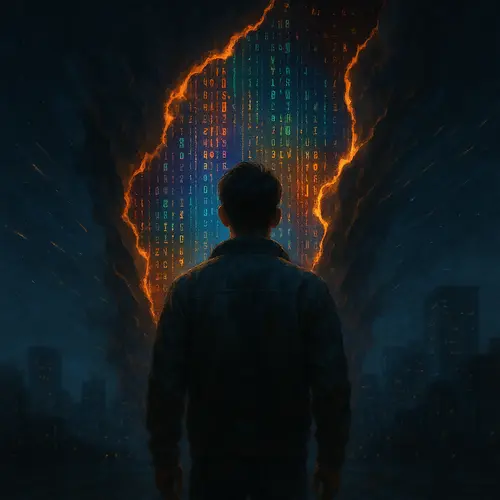
🧠 Introduction: What If Reality Isn’t Real?
Everything around you—your body, your memories, the screen you're reading this on—might not be real. Not in the traditional sense. What if you're inside a hyper-advanced computer simulation? A convincing illusion so vast and immersive that you can't tell it's not "base reality"?
This isn’t just the stuff of sci-fi anymore. The Simulation Hypothesis has been taken seriously by philosophers, scientists, and even billionaires shaping our future. What was once a Matrix-inspired fantasy is now an ongoing scientific and philosophical debate.
🧬 The Basics of the Simulation Hypothesis
The core idea is simple: advanced civilizations could create realistic simulations of conscious beings. If that’s possible, then it’s likely we are those simulated beings—because simulations would vastly outnumber real civilizations.
This argument was most famously articulated by philosopher Nick Bostrom in 2003, who offered a now-famous trilemma:
- Human civilization is unlikely to reach a posthuman stage before going extinct
- Advanced civilizations would have no interest in running ancestor simulations
- We are almost certainly living in a simulation
🖥️ Simulations Already Exist (Just Crude Ones)
- Video games simulate entire environments and characters.
- AI agents learn to drive cars or play chess in synthetic realities.
- VR allows users to inhabit digital worlds with growing realism.
If this trend continues, future simulations could include full conscious experiences. If humans can do it, then advanced civilizations elsewhere surely could—on unfathomably larger scales.
🧠 Could Consciousness Be Computed?
One major question is whether consciousness arises from complex information processing. If so, then a simulated brain running on a sufficiently powerful machine might feel as conscious as a biological one.
This idea underpins functionalist philosophy: it’s the structure and function—not the material—that matters. If true, consciousness might not care whether it runs on carbon or silicon.
🪞 Glitches in the Matrix?
While the Simulation Hypothesis is largely unprovable, some theorists look for indirect evidence:
- Quantum mechanics behaves unpredictably—as if rendering only when observed.
- The universe has a finite resolution (Planck length), like pixels in space-time.
- The speed of light could be a processing limit.
Are these just physical truths—or signs of an underlying code?
🧮 Mathematic Reality or Rendered Illusion?
Mathematical physicist Max Tegmark has proposed that reality is math. If so, then simulation may not even require hardware—it could simply be information evolving according to rules. We might be self-aware math.
📽️ Sci-Fi That Shaped the Theory
- The Matrix (1999): Humans unknowingly live in a digital world controlled by AI.
- Tron: A user enters a digital realm and interacts with self-aware programs.
- Black Mirror: Episodes like “San Junipero” and “White Christmas” depict uploaded consciousness in simulated realities.
These works aren't just entertainment—they offer philosophical test beds for exploring simulated existence.
⚖️ Ethical & Existential Questions
- If we’re in a simulation, does anything matter? Surprisingly, yes. Morality, meaning, and suffering still exist—for us.
- Do we owe anything to our simulators? Could they be observing? Testing? Evolving us?
- What if we build simulations within simulations? Recursive realities could create infinite loops of existence.
🔓 Can We Escape—or Wake Up?
Most versions of the Simulation Hypothesis suggest we can’t know for sure—or escape. If the simulation is perfect, any evidence we gather might be part of the design.
But some theorists think we could detect cosmic anomalies, edge cases, or computational limits that hint at the truth. Others believe psychedelics, meditation, or lucid dreaming might temporarily “glitch” the system.
📘 Final Thoughts
Are we in a simulation? Possibly. But more importantly: what would it change if we are?
Perhaps life’s value doesn’t depend on whether it’s “real.” Meaning might come not from knowing the source of the code—but from how we live inside it.
“Even if this is a simulation, it’s still the only one you get. Live accordingly.”