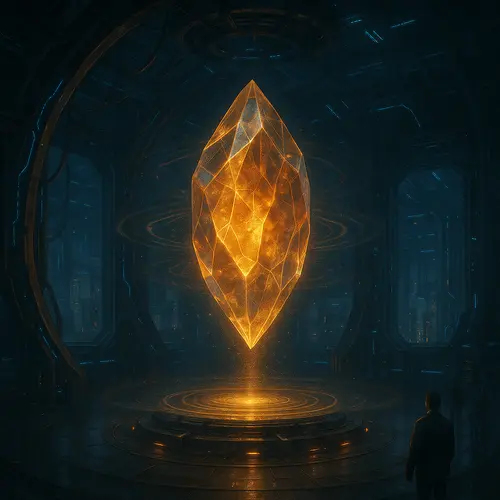
🧊 Introduction: The Crystal That Defies Time
Imagine a structure that never reaches equilibrium. A material that pulses rhythmically without consuming energy—oscillating not in space, but in time itself. It sounds like a sci-fi paradox, but this isn’t fiction. It’s one of the most exotic breakthroughs in modern physics: time crystals.
Originally theorized in 2012 and first realized experimentally in 2016, time crystals open a strange new chapter in quantum science—one that could reshape everything from computing to our understanding of temporal reality.
🔬 What Are Time Crystals?
In classical crystals like diamonds or salt, atoms are arranged in a repeating structure through space. In time crystals, however, the pattern repeats in time rather than space. They “tick” in a stable rhythm—even in their lowest energy state, known as the quantum ground state.
This violates what most of physics expects: that ground-state systems remain static. Time crystals, however, refuse to sit still.
⏳ Breaking Time Symmetry
In physics, time symmetry means that the laws of nature are the same at any point in time. A time crystal breaks that symmetry—creating a new phase of matter where the system evolves predictably in time despite no external input.
It’s like a pendulum that swings forever without friction or energy input. Impossible in classical systems. Possible—surprisingly—in quantum ones.
⚛️ How Do Time Crystals Work?
They rely on many-body localization and periodic driving. In simple terms:
- The system is driven by a repeating force—like a laser pulse.
- Instead of matching that rhythm, the system “echoes” it at a different, lower frequency—like responding every two pulses instead of one.
- This fractional response is stable and predictable—without consuming net energy.
This emergent behavior is not random; it’s governed by quantum rules. And it exists in a state that never heats up or reaches thermal equilibrium.
🧪 First Realizations and Experiments
Time crystals were first demonstrated by researchers at Google and physicists at Princeton and Harvard using:
- Trapped ions in electromagnetic fields
- Superconducting qubits in Google’s Sycamore quantum processor
- Diamond impurities acting as quantum memory
The results? Evidence of time symmetry breaking and long-lasting coherent oscillations—hallmarks of a time crystal.
💡 Potential Applications
- Quantum Computing: Time crystals could offer more stable qubits for error-resistant calculations.
- Energy-Free Clocks: Devices that “tick” forever without energy input.
- Fundamental Physics: New testbeds for quantum field theories and temporal symmetry research.
- Materials Science: Possible new quantum materials with exotic thermodynamic properties.
Time crystals are still experimental—but their potential is immense.
🧠 Philosophical Implications
Time crystals raise deep questions:
- Is time itself emergent, like space?
- Can matter exist in a perpetual dynamic state without entropy increase?
- Does this challenge the Second Law of Thermodynamics—or just bend it?
These structures don’t move through time like living things—but they mark time without dying. In a way, they seem to rebel against entropy itself.
📽️ Sci-Fi Echoes
- Doctor Who: Creatures trapped in time loops.
- Arrival: Non-linear time experienced by alien minds.
- Tenet: Reversibility and quantum symmetry in narrative form.
Time crystals aren’t yet time machines—but they do invite us to rethink how time behaves on the smallest scales.
🌌 What Comes Next?
As quantum computing matures, and our ability to manipulate qubits improves, time crystals may move from exotic lab curiosities to building blocks of future technology.
They also serve as metaphors—challenging our rigid intuitions about time, stability, and permanence.
📘 Final Thoughts
Time crystals are one of those ideas that seem to belong in the realm of metaphysics or science fiction—but they are now part of our physical world.
They don’t shatter clocks or break reality. But they offer a whisper of something deeper—a new phase of matter that pulses forever, echoing through time without consuming it.
“Time doesn’t always march forward. Sometimes, it dances.”