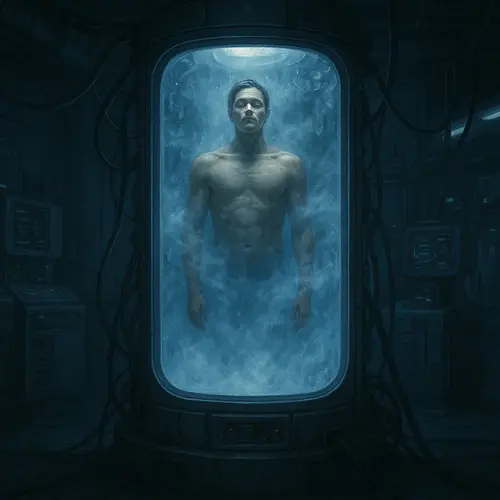
🧊 Introduction: Freezing Time, Escaping Death?
What if death isn't final? What if, instead of being buried or cremated, you could be frozen at the moment of death—with the hope that future technology might bring you back? That’s the bold promise of cryonics: preserving the human body in a state of suspended animation until science can revive it.
It’s a concept that blends science, hope, and science fiction. But is it real? Is it ethical? And does it offer a genuine chance at life after death—or just expensive deep-freeze fantasy?
🧬 What Is Cryonics?
Cryonics is the low-temperature preservation of a legally dead human (or animal) with the speculative hope of future revival. The body is cooled to below −130°C (often using liquid nitrogen) to halt decay and preserve cellular structures.
Importantly, cryonics begins after legal death—but before significant brain damage from oxygen deprivation. The hope is that future medicine will be able to repair or regenerate damaged tissue and restore full biological function—including memory and identity.
❄️ The Cryopreservation Process
- Once legal death is declared, the body is stabilized with chest compressions and cooling packs.
- The blood is replaced with cryoprotectant chemicals (a process called vitrification) to prevent ice crystal formation, which can shred cells.
- The body is slowly cooled to below −196°C and stored in a vacuum-sealed cryostat filled with liquid nitrogen.
- It remains there—possibly for centuries—awaiting the hypothetical day revival is possible.
🏢 Cryonics Facilities Around the World
- Alcor Life Extension Foundation (USA)
- Cryonics Institute (USA)
- KrioRus (Russia)
- Tomorrow Biostasis (Germany)
These companies offer full-body and neuro-only preservation (just the brain), with prices ranging from $28,000 to over $200,000—often funded through life insurance.
🔬 The Science: Hope or Hype?
As of today, no human has ever been revived after cryonic suspension. The technology to reverse the process—repair cellular damage, cure aging or disease, restore memory—is purely hypothetical.
However, cryobiology has seen some success in freezing and reviving sperm, embryos, and certain small tissues. Vitrification has improved dramatically. Scientists are exploring ways to scale preservation techniques to organs—and perhaps one day, whole bodies.
🧠 Why Just the Brain?
Some believe that identity and memory reside entirely in brain structure. Thus, preserving just the head (neurocryopreservation) may be enough. In theory, future tech could regrow a body or upload the preserved mind into a new vessel—biological or digital.
While it may sound morbid, this method is cheaper, logistically easier, and increasingly popular among transhumanists and life-extension enthusiasts.
📽️ Cryonics in Sci-Fi & Culture
- Futurama: Fry wakes up 1,000 years after being accidentally frozen.
- Passengers: Cryogenic sleep during space travel goes wrong.
- Altered Carbon: Preserved minds await reactivation in new bodies.
- Demolition Man and Vanilla Sky: Characters are frozen as punishment or preservation.
Science fiction has long played with the cryonics theme—sometimes as hope, sometimes as cautionary tale.
⚖️ Ethical Questions and Controversies
- False hope? Critics say it exploits people’s fear of death with no scientific basis.
- Identity preservation? Even if revival were possible, would it still be “you”?
- Future consent? Who decides to revive you—and for what purpose?
- Wealth gap: Will only the rich get to “pause” death?
Cryonics sits in a strange space—between medical science, philosophy, and futurist optimism. It sparks debate precisely because it challenges our ideas of what death is.
🌱 Cryonics vs. Other Longevity Strategies
- Biological rejuvenation: Reversing aging through gene therapy, stem cells, or senolytics.
- Mind uploading: Digitizing consciousness (if possible).
- Brain-machine interfaces: Gradual replacement or integration of biological and synthetic systems.
Cryonics differs because it doesn’t require solving aging now. It’s a bet on tomorrow’s breakthroughs.
📘 Final Thoughts
Cryonics is not a promise—it’s a possibility. A long shot. But for those who believe death is a problem to be solved, not accepted, it’s a leap of faith toward a distant future.
Whether it leads to resurrection, remembrance, or simply rest in cold silence, cryonics remains one of humanity’s most radical answers to mortality.
“We freeze people today, hoping the future will be kinder, smarter, and more capable than we are.”