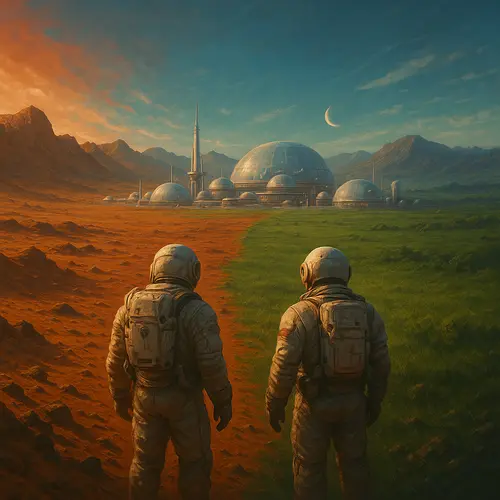
🪐 Introduction: A New Earth Among the Stars?
It’s one of humanity’s most audacious ideas: take a cold, barren planet and turn it into a second Earth. A world with breathable air, flowing water, and a thriving biosphere. Mars, our red neighbor, is the top candidate—and the concept is called terraforming.
Long a staple of science fiction, terraforming is now creeping into real-world scientific discourse. But is it possible? What would it take? And should we do it, even if we could?
🌌 Why Mars?
Mars is tantalizingly close in astronomical terms. It shares a 24.6-hour day, has seasons, and likely held water in the past. It’s rocky, not gaseous. It has poles and ice caps. It’s the best shot we’ve got for planetary transformation—at least in our solar system.
But it’s also a harsh, alien world: cold, dry, low-pressure, and bathed in radiation. Terraforming Mars isn’t about flipping a switch—it’s about reimagining physics, climate, and biology at planetary scale.
🔬 Terraforming in Theory: The Phases
1. Atmospheric Warming
Mars is too cold for liquid water to persist. The first step is raising the temperature by several degrees Celsius. This could release CO₂ from the polar caps and soil, creating a thicker greenhouse atmosphere.
2. Air Pressure & Greenhouse Gases
We’d need to increase atmospheric pressure to at least 10% of Earth’s level to allow unpressurized habitats. Proposals include pumping greenhouse gases (like super-potent perfluorocarbons) into the Martian sky.
3. Liquid Water Return
As temperatures rise, polar ice could melt, forming rivers, seas, and maybe an ocean in Mars’ northern basin. This rehydration is crucial for life and climate circulation.
4. Biosphere Seeding
Engineered algae, mosses, or extremophile microbes might begin the oxygenation process—slowly converting CO₂ into O₂. This process could take centuries or millennia but sets the foundation for more complex life.
🚀 Methods Under Consideration
- Orbital Mirrors: Giant reflectors to beam sunlight onto the Martian poles.
- Nuclear Explosions: Detonating bombs near the ice caps to jump-start warming (a controversial Elon Musk proposal).
- Factory Emissions: Building machines to pump out greenhouse gases.
- Importing Ammonia: Redirecting icy asteroids rich in ammonia to crash into Mars and release heat + greenhouse gas.
All of these ideas face enormous technological, logistical, and ethical hurdles—but they illustrate the scale of ambition.
⛅ Atmosphere Challenges
Mars has no global magnetic field to protect its atmosphere from solar wind. Even if we thickened it, it might slowly erode. Engineering an artificial magnetosphere—or rebuilding Mars’ internal dynamo—is a challenge beyond current science.
Also, Mars lacks plate tectonics and volcanism, which help recycle Earth’s CO₂ and regulate long-term climate stability.
🧬 Life & Ecology: Import or Invent?
Once conditions permit, we’d need to introduce life. But Earth ecosystems are finely tuned and fragile. Would they even survive on Mars? Do we design brand-new lifeforms adapted to Martian conditions? What if those lifeforms evolve unpredictably?
This phase moves from planetary science into synthetic biology—and speculative evolution.
🧭 The Ethics of Terraforming
This might be the biggest question of all—not can we terraform Mars, but should we?
- If Mars has microbial life: Do we have the right to overwrite it?
- If Mars is lifeless: Is it ours to reshape—like a blank canvas—or a cosmic heritage to preserve?
- Who decides? Terraforming is a project that spans centuries. Should it be governed by nations, corporations, or international space law?
📽️ Terraforming in Science Fiction
- Total Recall: Mars is made habitable by a hidden alien reactor that releases stored oxygen.
- The Expanse: Mars is a partially terraformed militarized world seeking independence from Earth.
- Red Mars trilogy (Kim Stanley Robinson): A hard-science saga on the political, social, and ecological complexity of terraforming.
Sci-fi reminds us that planetary engineering isn’t just science—it’s sociology, philosophy, and psychology at scale.
🌍 Terraforming as a Mirror
In our rush to shape new worlds, are we forgetting to take care of our own? Some critics argue that Earth, not Mars, should be our top priority. Climate engineering here might be more urgent—and more feasible—than planetary redesigns light-years away.
Others see terraforming as a backup plan—a Plan B for human survival. But if we can terraform Mars, why not re-terraform Earth?
📘 Final Thoughts
Terraforming Mars sits at the intersection of awe and arrogance. It’s a dream of cosmic scale, promising adventure, danger, and the ultimate expression of human creativity. But it also forces us to ask hard questions about stewardship, hubris, and the ethics of transformation.
Perhaps terraforming isn’t just about making Mars more like Earth—but making humans more worthy of both worlds.
“The Earth is the cradle of humanity, but one cannot live in the cradle forever.” — Konstantin Tsiolkovsky