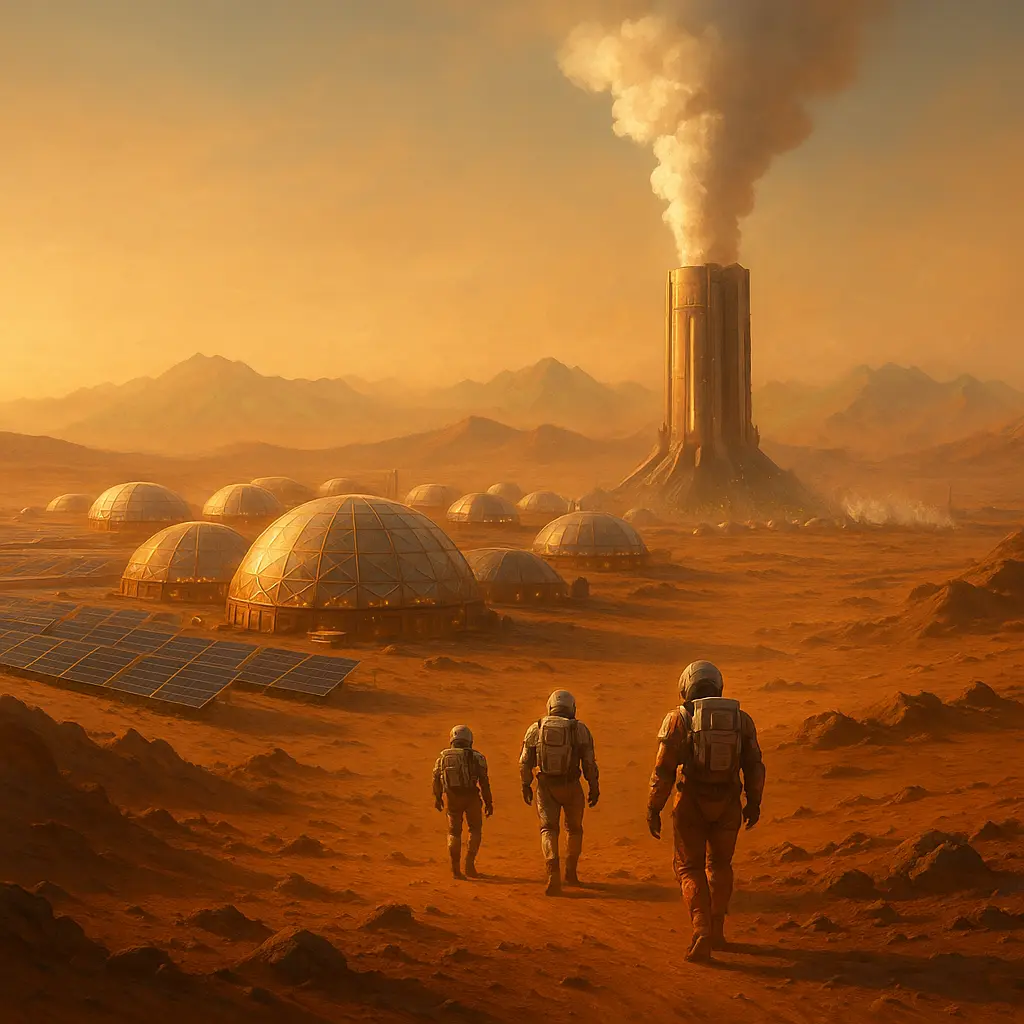
🏜️ Terraforming Mars: Science, Challenges, and the Future of a Red Planet Colony
Mars has been a mirror for human ambition for as long as we’ve had telescopes—and long before that, in stories told under dark skies. The modern dream is bolder than a flag on a hill: establish a thriving, resilient civilization beyond Earth, then nudge an entire planet toward habitability. “Terraforming” sounds like fantasy until you begin breaking it apart into the layered work of engineering, biology, governance, and patience. This guide treats the dream seriously: what we can do now, what may come within reach, what remains speculation—and how a real colony might grow from habitats sealed against the thin air to towns that breathe the planet’s weather like any other city on a windy plain.
🔬 The Baseline: What Mars Gives Us (and What It Doesn’t)
- Gravity: ~38% of Earth’s. Enough to keep atmospheres and bodies oriented; unknown long-term health effects for humans (bones, muscles, cardiovascular systems).
- Atmosphere: ~95% CO₂, very thin (~6–8 mbar at datum vs. ~1013 mbar on Earth). Too little pressure for liquid water at the surface without special conditions.
- Temperature: Average ~–63°C. Large diurnal swings; equatorial summer afternoons can touch 20°C, nights plunge far below freezing.
- Radiation: No global magnetic field; thin air means higher cosmic and solar radiation at the surface. Shielding is essential.
- Resources: Water ice (poles, buried mid-latitudes), regolith rich in oxygen bound in oxides, carbon in the air, nitrogen scarce but present, abundant silicon, iron, and sulfates.
- Energy: Excellent sunlight in equatorial regions (with dust-storm caveats), large temperature gradients for heat pumps, potential nuclear fission (and someday fusion), and limited wind potential.
🧱 Phase 0–1: From First Habitats to a Living Infrastructure
0) Site Selection & Landing
Pick regions that balance water access (buried ice), elevation (more atmosphere at lower altitudes for easier EDL and slightly better radiation attenuation), solar potential, and geology for ISRU. The northern lowlands near ancient shorelines and certain volcanic flanks are perennial favorites.
1) Closed Worlds Inside an Open One
Early life is “paraterrestrial”: pressure-sealed habitats (inflatable domes, rigid modules, lava-tube caverns) with integrated life support. Think cities-in-bottles. Key systems:
- ISRU (In-Situ Resource Utilization): Split water into O₂ and H₂; Sabatier reactors to turn CO₂ + H₂ into CH₄ and H₂O (propellant and water loop); regolith oxygen extraction.
- Power: Initial nuclear fission for baseline power; solar arrays with dust mitigation; thermal storage; closed-loop microgrids.
- Radiation Shielding: Regolith berms, water walls, polyethylene, or underground siting; storm shelters for solar events.
- Food: Controlled-environment agriculture: LED-lit hydroponics, aeroponics, mycoprotein fermenters, later soil-like bioreactors created from treated regolith and compost.
- Water: Ice mining, purification, greywater recycling with biofilm reactors; strong incentives to reach >95% loop closure.
🌱 Phase 2: Paraterraforming—Making Big Bubbles First
Full terraforming is an epoch-scale ambition. Before that, paraterraforming offers a practical bridge: enormous, pressurized enclosures (domes, arched canyons, roofed craters, sealable valleys) that provide Earthlike pressure and temperature over city or valley scales.
- Megastructures: ETFE films over truss frames; tensioned transparent membranes; self-healing coatings; dust-shedding electrostatics; regolith-based glass.
- Climate Control: Heat exchange with the outside, supplemental lighting, artificial “weather” cycles (mist, rain), and pollinator strategies (bats/bee analogs, robotic pollinators, or hand-pollination lines).
- Ecology: Start with proto-ecosystems: microbes → mosses → grasses/legumes → managed insects → small fish in recirculating aquaculture. Add complexity slowly; measure obsessively.
Paraterraforming gives immediate dividends: local shortsleeve zones, agriculture at scale, parks that feel like sky—even if the sky is an engineered ceiling.
💨 Phase 3: Atmosphere Engineering—Pressure, Composition, and Heat
To “open the bottle,” Mars needs more air and warmth. Strategies fall into three overlapping buckets:
- Release what’s there: Heat polar CO₂ deposits and regolith-bound gases to thicken the atmosphere (greenhouse leverage). Reality check: estimates suggest native CO₂ may be insufficient for Earthlike pressure, but it can help.
- Add greenhouse agents: Introduce short-lived radiatively active gases (e.g., fluorinated species) manufactured from Martian fluorine and carbon sources to trap heat while building pressure. Manage with strict environmental controls.
- Import volatiles: Redirect small icy bodies (very long-term and high-risk), or mine Deimos/Phobos and volatile-rich asteroids. Technically staggering, ethically fraught—yet not unimaginable in a multi-century plan.
Any plan must include feedback control: if the planet warms too fast, polar collapse or dust-storm feedbacks could destabilize progress. Terraforming resembles planetary-scale chemical engineering with a patient hand on the valve.
🛡️ Radiation, Magnetism, and the Sky Question
No global magnetosphere means more radiation at the surface and greater atmospheric loss over geologic spans. Mitigations:
- Local Shields: Habitat-level mass shielding (water, regolith) and active storm shelters.
- Atmosphere First: A denser atmosphere itself reduces surface radiation, especially for solar particles.
- Magnetic Interventions: Far-future ideas include artificial magnetic fields (e.g., a field source at Mars–Sun L1). For centuries, practical care beats grand magnetospheric projects.
🧪 Biology: Seeding Life Without Breaking It
Introducing Earth life at scale raises scientific and ethical questions. A careful sequence limits risk and maximizes learning:
- Microbial pioneers: Radiation-hardy, desiccation-tolerant microbes engineered to fix nitrogen (from sparse Martian N₂), cycle sulfur, and liberate bound nutrients from regolith. Strict containment during trials.
- Cryptogams & pioneers: Lichens, mosses, and hardy algae in paraterraformed spaces to initiate soil formation and organic carbon buildup.
- Managed ecologies: Closed biomes first, measuring nutrient loops, pathogen dynamics, genetic drift, and evolutionary surprises.
- Open introductions: Only after robust evidence that local conditions can support and constrain life responsibly.
Planetary protection isn’t a box to tick—it’s a relationship to maintain. We must balance scientific sanctity with a multi-planetary destiny.
🏗️ Cities that Breathe: Architecture, Urbanism, and Daily Life
- Early Urban Form: Clustered modules linked by pressurized corridors; transit via pressurized trams; freight tunnels below.
- Materials: Sulfur concrete (no water curing), sintered regolith brick, basalt fiber composites, regolith 3D printing, translucent regolith glass.
- Public Realms: Under-dome plazas with fountains (closed-loop), greenways for mental health, daylighting strategies with heliostat mirrors.
- Work: Mining ISRU, biotech, construction, robotics operations, data services, astronomy, and tourism (later).
- Culture: New holidays (First Light Day, Perihelion Fest), foodways around greenhouse output, arts that respond to thin air and red horizons.
⚙️ Logistics: The Silent Engine of Civilization
- Trade Lanes: Synodic launch windows dictate rhythms; stockpile critical spares; favor in-situ fabrication.
- Maintenance: Dust infiltration control, filter regimes, gasket programs, preventative care on everything from airlocks to algae bioreactors.
- Redundancy: N+2 philosophy for air, water, power; independent microgrids; cross-trained crews.
🔄 Circular Systems: Toward Net-Positive Life Support
Terraforming is less an act of adding stuff to Mars than it is an act of closing loops better than we ever have.
- Carbon Loop: CO₂ from air → Sabatier → CH₄ fuel + H₂O → electrolysis → O₂ for breathing/combustion.
- Nitrogen Loop: Scavenge trace N₂, mine nitrates if present, fix biologically in biofertilizer reactors; recapture from waste streams.
- Water Loop: >95% recovery with membrane bioreactors, forward osmosis, freeze-thaw concentration; ice mining to keep reserves high.
- Nutrient Loop: Blackwater → anaerobic digesters → biogas + digestate; digestate → fertigation; trace metals recovered via bioleaching.
📈 Timelines: Honest Expectations
- 0–20 years: Scouting, robotic industry, first crews, robust ISRU, paraterraformed pilot domes, limited agriculture.
- 20–80 years: Multiple settlements, regional paraterraformed valleys, serious agriculture, small export economy (knowledge, data, specialized materials).
- 100–300+ years: Atmospheric interventions beyond local domes; measurable pressure/temperature changes; intentional planetary stewardship policies.
Terraforming is an intergenerational project. The reward is a civilization that thinks in centuries again.
⚖️ Law, Ethics, and Ownership: Who Decides the Weather?
- Governance: From mission control to municipal councils to a planetary stewardship assembly as populations grow.
- Land & Resource Rights: Use-rights vs. ownership; stewardship obligations tied to extraction licenses; commons for air and water.
- Consent: Settlers, Earth stakeholders, scientific community, and future generations—how to include voices not yet born?
- Non-Human Stakeholders: If native microbial life is discovered, priorities shift radically; protection may trump habitation expansion in designated zones.
🧭 Risk Map: What Breaks, and How We Bend, Not Snap
Top Hazards
- EDL & Launch Failures: Redundant supply windows, in-situ stockpiles, local manufacturing of critical spares.
- Radiation Events: Forecasting + shelters + personal dosimetry; community drills.
- Dust Storms: Electrostatic dust mitigation on arrays, energy storage buffers, hab overpressure management.
- Biosecurity: Quarantine protocols, genomic surveillance of habitat biomes, antibiotic stewardship, UV/ozone sterilization cycles.
- Psychosocial Strain: Mental health infrastructure, meaningful work, greenery, communal rituals, regular Earth-contact windows.
🧩 Scenarios: Three Paths to a Breathing Mars
- Green Arcs: Riverlike bands of paraterraformed corridors connecting city-nodes. Think roofed canyons and sealed boulevards; the outside remains Mars, the inside is shirtsleeve.
- Blue Lens: Regional atmospheric thickening in low basins via greenhouse agents; partial pressure high enough for liquid water in controlled seasons; breathing still needs rebreathers.
- Open Skies Far-Future: Imported volatiles, managed greenhouse chemistry, biospheric seeding, and localized magnetic shielding. Children learn cloud names in Martian schools.
🛠️ A Practical Colony Checklist (v0.1)
- Power: 24/7 baseline (fission) + solar with 3–5 days storage buffer.
- Air: O₂ reserve for 60+ days, CO₂ scrubbers, leak isolation in all modules.
- Water: 95–98% recycling, ice mining capacity, storm reserves.
- Food: 50–70% local calories within 20 years; protein from legumes, microalgae, mycoprotein; vitamins from leafy greens & berries.
- Health: Rotating gravity labs (if feasible), radiation dosimetry, telemedicine, surgical capability.
- Mobility: Pressurized rovers, EVA suits with redundant life-support, dust-proofed bearings.
- Gov & Culture: Charter, dispute resolution, free time, art spaces, rites of passage for settlers.
🧠 Research Frontiers to Watch
- Low-Gravity Medicine: Countermeasures that work long-term in 0.38g.
- Biofoundries: On-planet genetic design for extremophile crops and microbes with strict ethical oversight.
- Regolith-to-Anything: Efficient oxygen extraction, sulfur cements, basalt fiber reinforcement, in-situ plastics from atmospheric carbon.
- Active Dust Control: Electrostatic clearing, superhydrophobic coatings, metamaterial surfaces for arrays and optics.
- Socio-legal Systems: Rights frameworks that reward stewardship and prevent enclosure of the commons.
🌍 Why Terraform at All? The Human Case
Critics ask: why spend centuries and fortunes nudging a distant world when Earth needs care now? The honest answer is both. Terraforming research demands better closed-loop life support, resilient agriculture, cleaner energy, and materials science that will first stabilize Earth systems. A second home is not an escape hatch; it is a school where humanity relearns limits, patience, and the physics of belonging.
📜 Final Thoughts: A Civilization That Thinks in Centuries
At its best, the idea of terraforming Mars doesn’t shrink Earth—it elevates it. It asks us to become engineers and gardeners at planetary scale, to tie ambition to duty, and to build institutions that will hold course long after their founders are dust. The children of the first Martian towns will read weather reports like poetry. They’ll know the taste of greenhouse strawberries and the sound of dust on domes. Some will become atmospheric chemists; some, muralists painting ceilings that pretend to be skies; some, poets of pressure and light.
Maybe one day those children will walk out of a valley whose roof has grown transparent and unnecessary. They’ll feel a wind carrying moisture from a lake that did not used to be there. They’ll look up and know their grandparents started the air they breathe. Terraforming will not be a switch flipped, but a story continued—chapter after chapter, a collaboration between science and time, between human hands and a red world that, slowly, learned to hold us.
On Mars, the longest project we finish is ourselves.