⏳ Introduction: What If Time Isn’t What We Think?
We take time for granted. It ticks forward, second by second, same for everyone. Or so it seems. But when we venture into the depths of space—or even just accelerate fast enough—time begins to behave very differently.
Welcome to the mind-bending world of time dilation: where astronauts age slower than people on Earth, and minutes in one frame of reference could mean years in another. It’s not science fiction. It’s Einstein’s reality.
🧠 What Is Time Dilation?
Time dilation is a phenomenon predicted by Einstein’s theory of relativity. In simple terms: time doesn’t pass at the same rate for everyone. The faster you move—or the closer you are to a massive gravitational object—the slower time moves for you relative to others.
This isn’t a metaphor. It’s measurable. It’s real. And it challenges our deepest assumptions about time and reality.
🛰️ Two Causes of Time Dilation
1. Special Relativity: Speed Slows Time
According to special relativity, as an object approaches the speed of light, time slows down for that object relative to a stationary observer.
Example: If you boarded a spaceship traveling at 90% the speed of light and took a round trip lasting 10 years (by your clock), you might return to find 25 years passed on Earth.
2. General Relativity: Gravity Bends Time
Massive objects—like stars, planets, and black holes—warp spacetime. The stronger the gravity, the slower time flows near it.
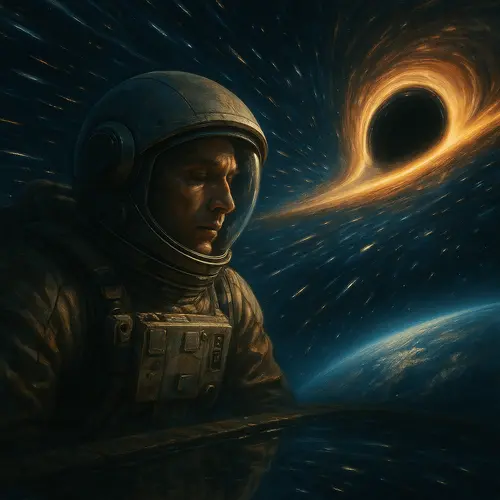
Example: An astronaut orbiting close to a black hole experiences time far slower than someone far away. What feels like an hour near the black hole might be a decade elsewhere.
🧪 Proof That Time Dilation Is Real
- GPS satellites orbiting Earth must adjust their clocks to account for both gravitational and speed-based time dilation. Without correction, GPS would become inaccurate within minutes.
- Muons—particles created in Earth’s upper atmosphere—last longer (from our point of view) because they’re traveling so fast. Their lifespan stretches due to time dilation.
🎬 Time Dilation in Sci-Fi
- Interstellar (2014): A planet near a black hole experiences massive time distortion—1 hour there equals 7 years on Earth.
- Planet of the Apes: The astronaut returns to Earth, only to find centuries have passed.
- Light-speed Travel Tropes: Common in many space-faring sci-fi, where astronauts age slower than their loved ones back home.
These aren't just plot twists—they’re grounded in real physics.
🚀 Implications for Space Travel
If humanity ever builds starships capable of traveling near light speed, or explores regions near extreme gravity, we’ll face the reality of relativistic time drift. This means:
- Time on Earth and on board will desynchronize.
- Spacefarers might return home to a vastly changed world.
- Communication between ships and Earth could lag not just spatially—but temporally.
Deep space travel may not just be a journey through distance—but through time itself.
📚 Philosophical Reflections
Time dilation shatters the idea of universal time. It suggests that time is not absolute—it is experienced differently depending on your frame of reference. In essence:
There is no single now.
This raises profound questions: If the present is relative, what is reality? What does it mean to exist in time at all?
🔚 Final Thoughts
Time dilation is not just a quirk of equations. It’s a window into the strange, beautiful, and flexible nature of the universe. Our everyday intuition about time works on Earth—but it begins to crack in the cosmic arena.
As we reach for the stars, we may find that time itself becomes our greatest mystery—and our greatest discovery.
“The distinction between past, present and future is only a stubbornly persistent illusion.” — Albert Einstein