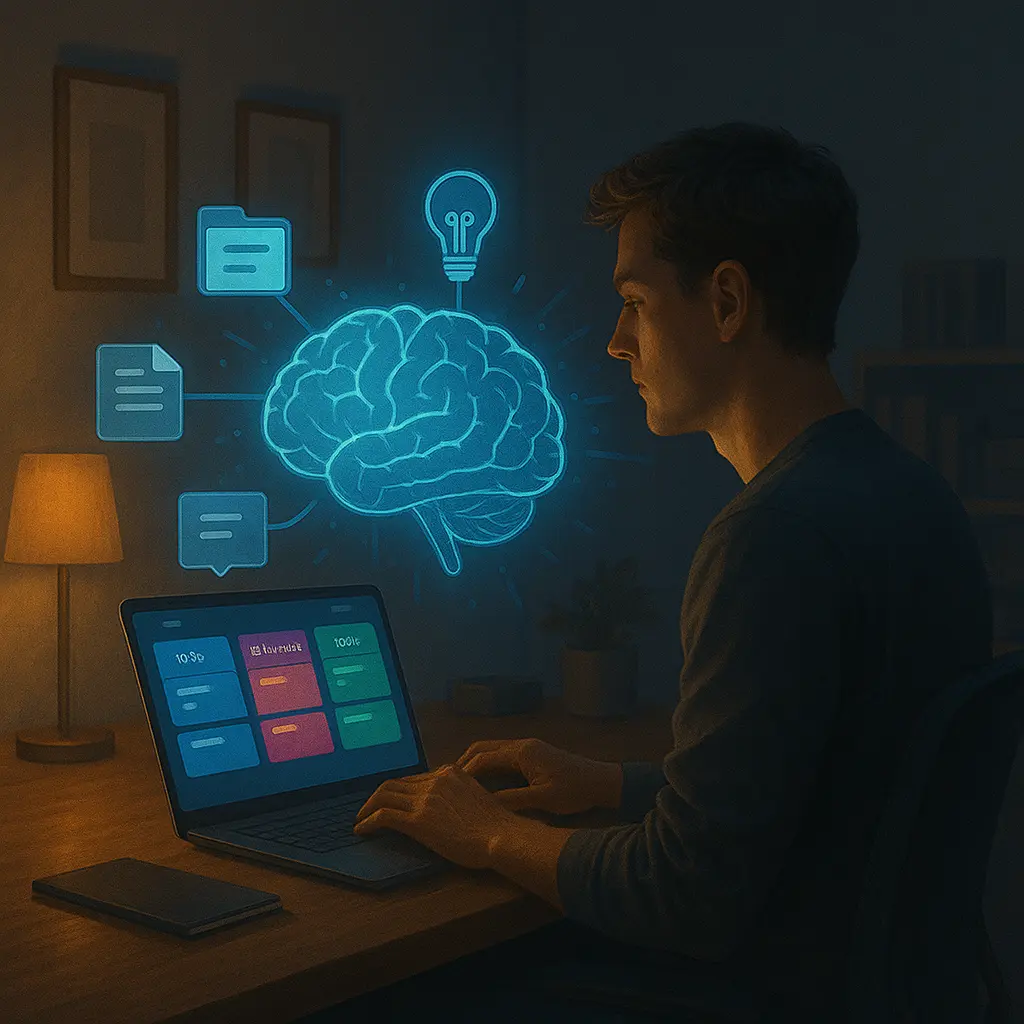
🧩 Introduction: Why You Need a Second Brain
In today’s world, we’re bombarded with information—articles, ideas, insights, quotes, conversations. If you’ve ever felt overwhelmed by the sheer volume, you’re not alone. Our minds were designed for survival, not for remembering every useful thing we encounter.
That’s where the idea of a Personal Knowledge System—or a “Second Brain”—comes in. By creating a reliable way to capture, organize, and retrieve what matters, you free up mental space for creativity, problem-solving, and meaningful work.
🔬 The Science: How Externalizing Memory Supercharges Your Mind
Research shows that “cognitive offloading”—moving information from your brain to an external system—reduces stress and increases clarity. Your brain is a connection engine, not a storage device. The less you use it for remembering, the more you can use it for thinking.
This approach powers creative breakthroughs, helps you connect distant ideas, and boosts your ability to learn new skills fast.
🛠️ The 3 Pillars of a Personal Knowledge System
- Capture: Save insights, quotes, resources, and ideas—no matter where they appear (books, web, conversations, podcasts)
- Organize: Use categories, tags, or folders to connect and group related knowledge
- Retrieve: Build habits of reviewing and using your notes—turn knowledge into action
The system doesn’t need to be complicated. Even a notebook can be a powerful “second brain” if used consistently.
📚 Choosing Your Tools: Analog or Digital?
- Analog: Bullet journals, commonplace books, index cards
- Digital: Notion, Obsidian, Roam Research, Evernote, OneNote, Google Keep, Apple Notes
Start simple. The best tool is the one you’ll actually use. You can always switch or upgrade later.
🔖 A Simple Workflow for Knowledge Capture
- Quickly jot down new ideas or quotes—don’t overthink it
- Once a week, process and organize your “inbox” of notes into clear categories
- Tag or link related notes so you build connections, not silos
- Set aside review time (weekly, monthly) to revisit your notes and spark new insights
Remember, organization is less important than retrievability. If you can find what you need when you need it, your system is working.
🧠 From Note-Taking to Note-Making
Don’t just store knowledge—interact with it. Summarize books in your own words. Connect new ideas with past learnings. Ask questions and write down your answers. This active engagement is what transforms notes into wisdom.
💡 Tips for Building a Second Brain That Lasts
- Start with one central tool and master it
- Keep your workflow frictionless—make capturing and reviewing notes easy
- Review and update regularly—a stagnant system quickly becomes clutter
- Don’t strive for perfection—aim for “good enough” to support your learning and growth
🌱 The Benefits: Why It’s Worth the Effort
- Never lose a great idea again
- Reduce mental clutter and information overload
- Unlock creative connections and “aha” moments
- Accelerate personal growth and mastery
- Build your own “Google for your mind”
🚀 Final Thoughts
Your brain is brilliant—but it’s not a filing cabinet. By designing your own Personal Knowledge System, you invest in your future self’s clarity, creativity, and growth. Over time, your second brain becomes your greatest ally on the journey to mastery.
“You can only connect the dots you collect.” — Tiago Forte